April 20, 2026 | Sustainability
Cultivate Hope’s Full Circle Sustainability
How Matthew 25’s New Composting System is Closing the Loop
In the kitchen at Groundswell Cafe, vegetable peels are set aside instead of tossed. Coffee grounds are collected. Pineapple skins, pepper ends, and food scraps are no longer thrown away. Instead, they begin a journey back to the soil.
 Earlier this year, compost bins began appearing in the Groundswell kitchen, the Cultivate Hope Corner Store, and even the Matthew 25 employee breakroom. Thanks to a grant from the Giacoletto Foundation, our urban farm manager, Anyssa Ball launched a comprehensive composting system at Matthew 25, one that creates a true full-circle model of sustainability.
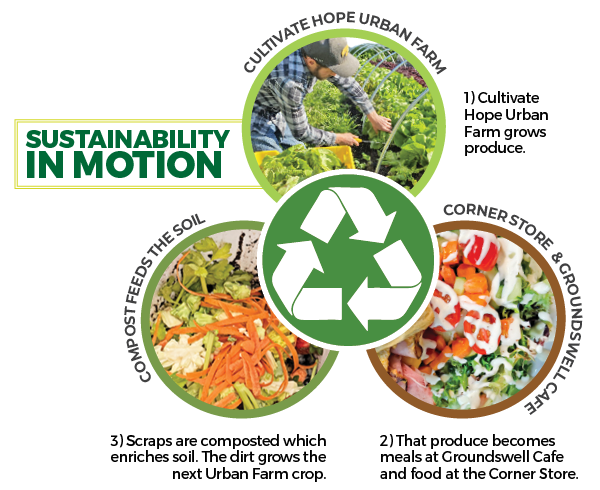
The cycle is simple and powerful: produce is grown at the Cultivate Hope Urban Farm.
That produce becomes meals at Groundswell Cafe and food at the Corner Store.
Scraps and trimmings are composted. Compost feeds the soil. And the soil grows the next Urban Farm harvest. It is sustainability in motion.
Compost as a Resource
Composting has long been important at the Urban Farm, but this new system allows Matthew 25 to do it intentionally and efficiently. In the past, the farm relied heavily on compost from the Linn County Solid Waste Agency or purchased compost to maintain soil fertility.
“We produce a lot of plant waste and food scraps,” Anyssa explains. “Knowing that these materials can be used as an asset instead of being thrown away is important.” That’s the goal.”
In fact, Matthew 25 can now divert an estimated 20–30 gallons of waste each week from the dumpster into compost systems. “Part of the issue with food waste is that it’s a failure of the system if it goes into the landfill,” Anyssa says. “There, it turns into methane gas, which is not good for the environment.” Instead of contributing to that problem, Matthew 25 is helping solve the problem.
Healthy Soil, Healthy Community
Composting is about much more than reducing waste, it’s about building living soil. “Years ago, soil was thought of as inert,” Anyssa explains. “Now we understand that soil is a living ecosystem.”
 Healthy, organic-rich soil improves water retention, aeration, and nutrient availability. Unlike synthetic fertilizers, compost releases nutrients slowly, reducing runoff and supporting long-term soil health.
Healthier soil leads to healthier plants and ultimately healthier food. “It’s all connected,” Anyssa says. “Public health, environmental health…it all ties together.” From the Urban Farm to Groundswell Cafe and the Corner Store, that connection becomes tangible, something we can grow, share, and eat.
Healthier soil produces healthier plants and ultimately healthier food. “It’s all connected,” Anyssa says. “Public health, environmental health…it all ties together.”
The Bokashi Advantage
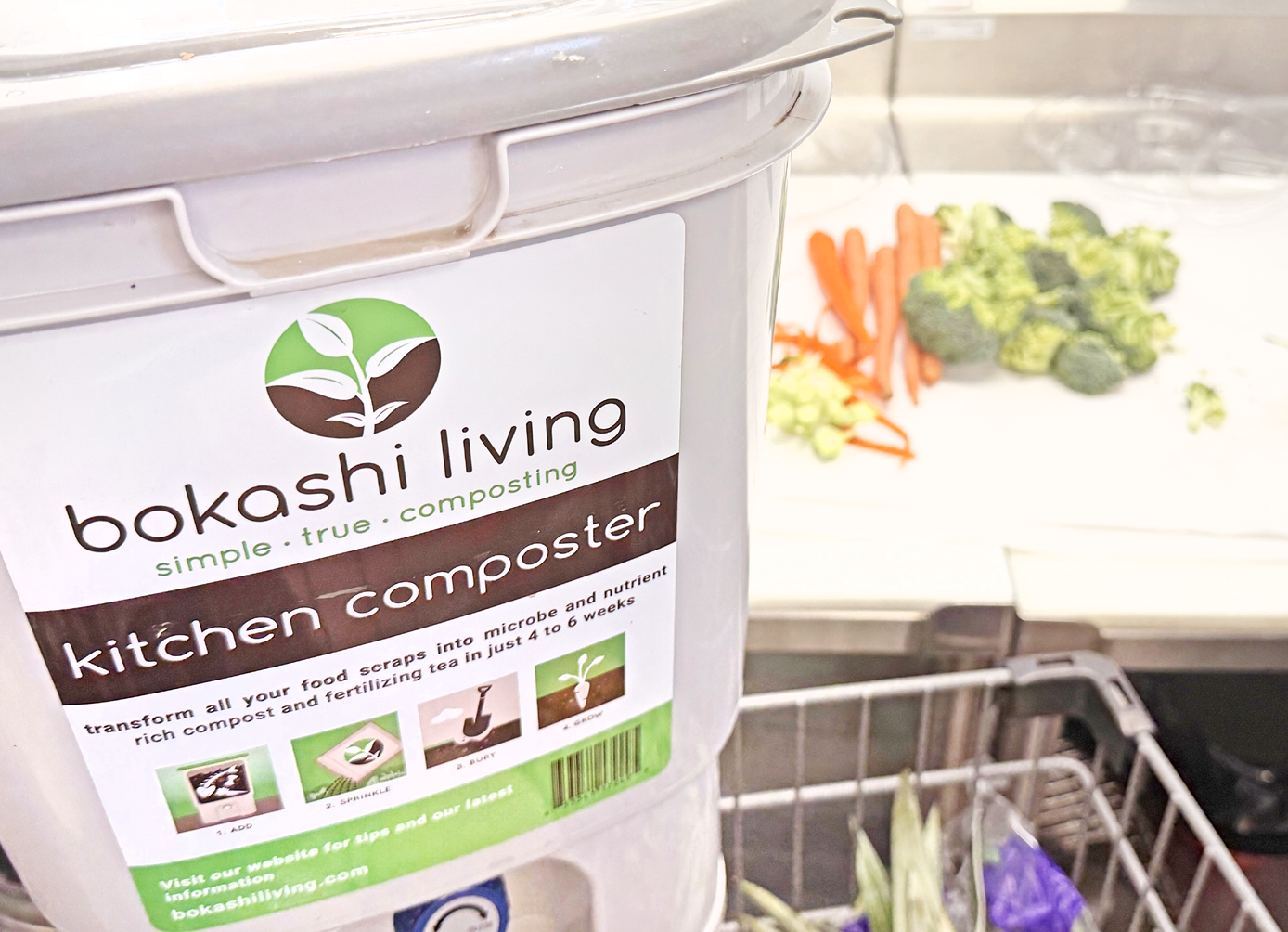
At the Corner Store, composting goes even further. Because meat is cut in-house, bones and trimmings that cannot be consumed are collected using a Bokashi composting system. This system is a fermentation-based pre-composting method that safely processes animal byproducts before they are added to traditional compost piles.
“Bokashi allows us to compost materials that wouldn’t work in a traditional system,” Anyssa explains. After fermenting for about two weeks, the material can be added to compost piles or buried directly in the soil.
Education and the Future
For Anyssa, composting also aligns deeply with Matthew 25’s mission of education and community engagement.
“This is a fantastic opportunity for science learning,” she says. Youth Development Program students can compare systems, understand ratios, and observe how organic matter transforms into fertile soil.” This will also create learning opportunities for school field excursions and food camps held on the farm. Finally, the urban farm intends to offer public seminars so that others can learn how to compost at home.
With this new composting system in place, which includes Bokashi, passive bins, and a three-bin quick compost system, students can compare methods, see decomposition in real time, and learn how different approaches affect the process.
We are thrilled that these composting systems allow for more in-depth STEM study. Students acquire hands-on problem-solving experience by comparing systems and troubleshooting issues, as well as understanding how nutrient cycles affect soil health and crop yield.
Anyssa’s vision for the future is clear: “The more the Urban Farm can be an ecosystem unto itself, the better. At the Urban Farm, we respect the cycles of nature and work together to make them better.”
From soil to supper and back again, Matthew 25 is demonstrating that sustainability is not just about reducing waste. It is about restoring balance. It is about stewardship. It is about resilience.
And it is about recognizing that when we care for the soil, we are caring for our community.
Read more from our Spring 2026 newsletter